Showing posts with label technology. Show all posts

Friday, October 31, 2014

Relationship Building and Determining Worth

Happy Halloween!

Like the Introduction, Chapter One of Spreadable Media contains many opportunities for discussion in the world of online and blended learning. The title, "Where Web 2.0 Went Wrong," shows the focus on a tension existing and intensifying between commercial media and fan culture. Fans desire to remix and appropriate media, often not for profit, but some commercial media believe this infringes on their creation and seek to shut things down. Here are places I want to explore more:


Moral Economy
The book discusses the idea of a moral economy, a term from E.P. Thompson from 1971. A moral economy illustrates a "perceived moral and social value" of transactions whether those interactions are explicitly stated or not (52). A shift in the structure of the interactions can result in "diminishing the level of trust among participating parties" (52). To me, what does this mean? We're back to SCARF. The book does not mention SCARF, but it should right here. This is all about SCARF.

Online and blended learning dramatically shifts the structure of education. The learning changes, and so do the interactions. Trust diminishes, especially when teachers do not work to build relationships with students and take the time for community building. Trust in others in the class can also diminish without those community building opportunities, since students rarely "see" the other students can be alone. Other trust diminishes, too. Trust in the integrity of the work exists between traditional models and blended / online models. Time and communication can rebuild the network of trust, but ignoring this will not make it go away.

Other aspects of the moral economy also need discussion. What is the perceived expectation of how an online class works, or how one should participate in an online / blended class? What if the structure and delivery of the class does not meet those perceived expectations? How do we discuss these things in a way to move into the authentic work? One way is to take the time to build norms together. I've collected some resources on norm buildingat this livebinder site (code: communicate2learn). Sites like Tricider can also get the discussion started. For example, I'd love feedback on this one: 


Community building and dealing with SCARF absolutely takes time away from content, but I believe the benefits outweigh this. 

Engagement and Branding
The previous post discussed what spreads versus what sticks. Chapter One delves into this more with this idea about motivation behind spreadable content, "Users generating online content are often interested in expanding their own audience and reputation. They may measure their success by how many followers they attract on Twitter, just as television executives value the number of eyeballs their programs attract" (60). The chapter continues, "When audience members spread this content from one community to another, they do so because they have a stake in the circulation of these messages. They are embracing material meaningful to them because it has currency within their social networks and because it facilitates conversations they want to have with their friends and families" (60). This means that students will spread not only what is meaningful to them, but also what they feel helps identify them to the world and to the people they care about. Authenticity. They need to have a stake in the work. For example, my son, a sophomore, thinks about how he wants to be perceived often. He devotes a lot of time and energy putting up videos of him doing Parlour or freerunning because he is a part of that community and wants to spark conversation and receive feedback. Here's an example of one: 


Engagement for him, like for all his peers, depends on providing something to him that he can make meaning from, have a stake in, and care about. The chapter argues that being engaged also "recognizes that these communities are pursuing their own interests, connected to and informed by those decisions made by others within their social networks" (60).  For him, the videos are a way to "give back" and contribute to the community in some way, including tutorials he has made for difficult flips and such (they are longer so I didn't post them here). His videos reflect someone engaged in a community, someone who can "feel an obligation to 'give back' to their 'community' and/or in the hope that their actions will direct greater attention and interest to the media they love" (62). He communicates his love for the mindset of Parkour and for the community with each video he makes, each comment he posts. Every entry strengthens his ties to Parkour and the community.  How can we find ways to tap into the areas of life where students already feel they have a stake in something? How can we also be attentive to the fact that they are trying to create an identity for themselves that may not include our subject?  How can we design learning experiences that would allow the students to "give back" to their communities? Choice. In skill-based learning objectives, such as in ELA and other subject areas, providing choice can be easy and an instant way to engage students in creating learning objects that mean something to them - makes them want to spread and transfer what they learn beyond the boundaries of the school. That means I'm back at UDL
  Sometimes the learning objectives just don't match their passions as directly as we would like. I think one way stems from the discussion of an academic identity. We communicate via academic emails, and then maybe we should create academic accounts. I've had students tell me that they didn't want to tweet because the classroom tweets would show on their feed to their followers, and that wasn't the image they were crafting. I get that. For those instances, then, an academic account would serve their purposes. If my son doesn't want the people who follow his channel for Parkour to see him creating a video of a catapult in Physics, an academic account would ensure that would not happen. Their identity / brand remains intact and they can participate more freely. A class account for some things would work equally well.   
The Notion of Reciprocity and Exchange (Value vs. Worth)
The chapter ends with a discussion of commodity view versus an exchange / gifting view. This is a topic I've done a lot of research about. I've looked at two different series with a gifting mindset in two different anthologies: 


Tolkien Book Cover

 and

Hunger Games and Philosophy


 In this regard, the gifting mindset works "as an analogy for the informal and socially based exchanges which characterize some aspects of the digital ethos" from Howard Rheingold's The Virtual Community (65). 

One complaint about online/flipped/blended experiences is the belief that the burden on teaching falls on the student. To me, this complaint hits on many areas of Chapter One. The expectations of being "taught" do not seem to be met, which diminishes trust. A non-personalized click-through experience does not engage, which means the student may make no meaningful relationships. The reciprocity cannot be there if the students perceive they are doing all the participating in the course. The facilitator has to dig in, build the relationships, provide the feedback and teach. Otherwise, there is no balance. We step in when we design for choice, provide meaningful, timely feedback, and protect students from adverse consequences.

 To me, the facilitator's role parallels the role of the marketer in the fan/commercial relationship described in Chapter One, where the authors say that Gould claims the marketer (here the designer/facilitator), "build relationships through listening and interacting, deepening relationships with audience members when it's contextually relevant" and intentionally trying to "pay attention to the audience's agency" (80).

In Chapter One, the idea of a "gift" in digital environments "depend on altruistic motivations; they circulate through acts of generosity and reciprocity, and their exchange is governed by social norms rather than contractual relations. The circulation of gifts is socially rather than economically motivated and is not simply symbolic of the social relations between participants; it helps to constitute them" (67). Using Lewis Hyde's distinction between value, a commodity, and worth, a gift, the question then becomes one of worth. 

We are right back to meaningful experiences. Worth comes from a sense of personal meaning and relevance. Something worth creating should be something worth spreading and sharing, be it through an e-portfolio or a video.
   

Friday, May 9, 2014

Music to my Ears...

It's Friday, and because the post is about music,  here is my song for the beginning of the weekend:


Music has always played a large part in my life. My mother works as a Director of Music and has played the organ in many amazing places. I remember as a child being up where she practiced, sometimes turning the pages. Growing up, I learned to play the piano, the oboe, and the guitar. I'm very glad that my children enjoy playing music and listening to it as well.

Over the last few years, my mother has taught Music Appreciation at the college in her town. She also teaches a great class on occasion for teachers: using music in the regular education classroom (I know I'm getting that title wrong, so I'm not capitalizing it). During one visit, she asked me to speak to the soon-to-be teachers about how I weave music into the classroom, so I'm sharing some of that today:

Playlists - For years I've kept playlists for different units of teaching. In it, I kept things such as:
- thematic connections - popular music for older texts to breach the distance of time and help students connect. For example, when talking about Chaucer and courtly love, students often thought the rules about jealousy and instant love were ridiculous. For them, extreme jealousy = stalking and physical symptoms of love seem silly. But when I play something like this:


Or this:

They begin to rethink how we talk about love culturally. Asking them to go find their own examples and compare them to depictions of love in Chaucer or in the rules of courtly love help as well.
- cultural connections - In Beowulf, for example, there is mention of the woman who "sang sorrowful" during his funeral. Letting them hear a version of a keening song, for example, helps them understand the context of the singing in a deeper way:

- changes in point of view - one popular form of expression in participatory culture is to write songs and stories from a different point of view than that chosen by the author. For example, in the Harry Potter world, here is a song from the Ministry of Magic from the point of view of Voldemort and Lily:

On a more academic note, collecting songs with different points of view about war, such as "The Green Fields of France":
to contrast with a song such as "Praise the Lord and Pass the Ammunition":
with some modern songs today about the effects and beliefs about war can add a new, emotional layer to facts that might seem dated and too far away to be relevant.
- content review - For me, there is nothing better than historyteachers when I wanted content review. I could show them this about the plague to just give them the little bit of information I needed before reading "The Pardoner's Tale" and ask them to be ready to share what they think the most important thing to remember about the plague might be to spark discussion:
Or this after Beowulf to ask the students to evaluate the song and determine if the song highlighted what, to them, were the important messages of the text:
- content enrichment - When moving into Romanticism, students struggle a lot with long, abstract texts like Coleridge's "The Rime of the Ancient Mariner." Even though Coleridge provides his own version of Cliff's Notes to sustain the reader, students struggle with the overall concept. What I wanted them to understand with this poem, and with Walton's experience in Frankenstein, was the relationship between the sailor and the sea. I wanted them to understand the mystery, the danger, the pull the sailors feel. For that, I used a variety of sailor songs including "The Sailor's Prayer" (this isn't my favorite version but I like it without instruments - try the one by Pandora Celtica - it wouldn't load):


or "The Mingulay Boat Song"- this is by a local group that unfortunately no longer performs:

 or the song "White Squall":


- creating a soundtrack for in-class reading - For sharing important moments, I tried to find appropriate soundtrack music, which helped the students remember but also emotionally connect. A lot of people today are creating battle mixes while playing video games, so this is a great connection for them. So, for example, with Beowulf's fight with Grendel, I would play battle music from a mix such as:


After going through my playlist with them for the unit (I'd never hit all the songs in the playlist), I'd show them the list and ask them to make their own. I received great examples that I added to mine over time. The Ministry of Magic addition, for example, was from a student.

Figurative Language - Music can reinforce ideas about figurative language in a variety of ways. Here are some of the ways I've included music:
- tone - It's important to note that music alone can change the tone of a piece. Music can help students develop a vocabulary of tone words, because some can describe how music feels more easily than words. In looking at how tone can change dramatically, I like to choose two very different versions of the same song, such as Europe's "Final Countdown":

With Laibach's version of "Final Countdown":

I choose Laibach intentionally because they have done covers of this as well as songs by Queen such as "One Vision" for a deliberate reason that has a lot to do with music and tone. Their story is fascinating and can be found here, where an article calls them the "unlikely godfathers of Occupy and Anonymous" and here.

Another fun way to explore tone is with the very popular YouTube tendency to remake trailers into a whole new genre. For example, here is a realistic, original trailer for Cinderella:

and here is a remix with scenes from the same movie but altered music and selection of images:

Students can generate tone words and describe how the music changes the tone. Later, students can create their own sets of trailers or other pieces for tone exploration. This ability to play and remix cultural pieces is another component of participatory culture that students identify with and enjoy doing.

- allusion - Allusions are our conversational shortcuts. We use allusion to bring in cultural knowledge without having to explain certain elements that would distract from the main point. While expanding their allusion vocabulary so that students can better participate in those conversations, I often used music to support the notion that these kinds of terms are everywhere. By far, students enjoyed this one the most and often danced in their seats:
But there is also Enter the Haggis's "Icarus" which goes well with Breugel's painting and Auden's poem - really showing how an allusion can appear in many forms and how texts can carry on a dialogue over time. There is a long instrumental beginning, so it's a good time to show other art depicting the Icarus story:
After a few examples from me, the students are off and running. They begin to see and hear the allusions everywhere, which is what I want. We collect examples in a forum, musical or otherwise, and I ask them to bring in music that depicts an allusion, like thirty pieces of silver, to see if other classmates can determine the meaning underneath.

Research abounds discussing the benefits of music in classroom learning. Vh1 collected much of it for their "Save the Music" campaign, and that can be found here. While it focuses on formal music education, some of the quotes also discuss music and learning in general. Here is an article that discusses wider uses of music in forms such as the long-popular Schoolhouse Rock pieces (my daughter was humming the one for the Constitution as she took her test just last week) to modern rapping with math. The National Council of Teachers of Mathematics offers a grant for using music to teach math in early grades. The American Historical Association provides this resource for using music in a social studies setting and illustrates how to incorporate music in a variety of ways, including like the example of different points of view I listed above. Finally, this Edsource article shows how the California State Standards called for implementation of music.

Even with online learning, our team talked about music implementation just a week ago, and we all shared a variety of strategies. Sharing music with the students helps forge a relationship and can show them new sides of our personality. While teaching content, to start a collaborative session, or as a creative opportunity, finding ways to weave music into a course brings a new layer to the content itself.

Saturday, April 5, 2014

Never Enough Time!

This week time seemed to just elude me - everything took longer than it should have. Whether it was working on a particular site or just trying to print, all of it took longer than I expected. Last week, time was the enemy. I felt like this teacher who just wanted to get out simple directions and got waylaid in the process:


To be productive, I had to reprioritize, which means the usual Friday posting is getting done on Saturday. I know I'm not the only one who has had weeks like this. Because of that, this week I wanted to post about ways to save time:

- Changing the work - so all can work smarter not harder - 
This article from Edudemic lists some of the more popular technology tools out today. Within the description, you can see all the different ways teachers use these tools to not only engage students but also to improve the overall working of the class.

This site provides technology solutions to several aspects of a teacher's life that eats a lot of time. Some of them seemed obvious, but there are some interesting options out there I had not considered as well.

- Working on what matters - 
When reading about best practices, where do they tell us to emphasize our time?
What work do we invest in that brings the best results in our students and in our own work as educators?
For example, this study by Allingham and Belanger reveals student opinions about teacher feedback. Based on this study, and others since with similar results, teachers can see where to spend their time providing feedback in a way that improves writing and where to spend less time because the feedback is not as effective.
In addition, what kinds of formative assessments can quickly inform you as the educator how the student is managing the content and where/how the teacher can provide additional support? This site and this site look at technology and formative assessment and suggest different options depending on the goals of the implementation. This site lists others but does not provide as much information. We can use formative assessment to guide the process, allowing us to work on what matters. With help from some of these tools, that information can arrive to us quickly and in a variety of ways.

- Realizing limitations - 
Finally, this article comes from a site in the UK devoted to strategies for time management for teachers. In this particular post, the article talks about achieving a sense of balance and knowing our limitations. For me, this meant letting it be okay to leave something until tomorrow. The world kept spinning, so I guess some things really can wait...

Monday, March 31, 2014

Raising the Dead (Languages, that is...)

I am a huge fan of Chaucer's blog posts and tweets. When he made this post earlier in the month celebrating "Whan that Aprille Day," I knew I wanted to find a way to participate. No longer in the classroom, I struggled with a way to encourage the revival of dead languages. My Master's work focused on Anglo-Saxon riddles, and I wrote an article for publication focusing on a tale in Canterbury Tales, so those languages in particular hold much interest for me, and I am focusing on these two languages. Kenneth Burke once wrote in Counterstatement that remoteness from what is being studied can impair the ability for the audience to connect with the text. This means that students enter already predisposed to find no relevance in older languages or their stories. We have to work that much harder to not only find the relevance, but also to hopefully inspire a love for these languages.

With that in mind, I wanted to post this week about ways to participate in "Whan that Aprille Day" within on online / blended setting for Middle / High school:

- Let students listen to the languages - Because many students read translations, they do not know what the languages sound like. Letting them hear the language, preferably more than once by someone who knows the language well enough to use inflections and emotions when reading the words, helps the students gain a new awareness of the text. Here are some options:

One example is Bagby's Beowulf. Here is an excerpt from the opening lines:


In the past, when I've shown this excerpt, my students (and my own children) were transfixed. My son watched the whole DVD. This clip gives them a sense of how this text was a story told to an audience, and it reminds them that the storytelling piece of this helped determine structure.

Michael Drout's Anglo Saxon Aloud site contains recordings of Drout reading Anglo-Saxon texts and includes poetry, prose, saints' lives, and more.

For Middle English, examples include this video from historyteachers introducing Canterbury Tales with a recitation of the prologue:


Another approach with a direct recitation of Chaucer can be seen at this site, which was an early entry celebrating "Whan that Aprille Day." Finally, there is the rap:


After viewing some recordings, the students can make their own and include an excerpt from the original language. Like the last two videos, the students can strive to bring the context for the recitation into a more contemporary setting that shows the relevance. For Middle English, the students can consult the pronunciation guide here.

- Exploring manuscripts - This site allows viewers to explore manuscripts. I think letting students see how the original works look on the page, when possible, provides another opportunity for the students to connect with the text, author, and audience. This site offers ideas for teaching with manuscripts. Finally, this site uses Thinglink to introduce the Anglo-Saxons, but I think that Thinglink would be a great place for students to analyze a manuscript or images of a manuscript. I could see an image from Chaucer's prologue with an analysis of the pilgrim and the devices Chaucer uses in his description.

- Progression of translations - Some frozen texts can be examined as the language changes over time. By looking at the progression of language, students can visually watch the words change and morph into modern wording. This site from Rice shows the progression of the Lord's Prayer from Anglo-Saxon to modern English. When there is no ready-made progression, even a dual language text can remind students of the original language while reading a translation. Here is one for Chaucer's Prologue and here is one for Beowulf.

- A study in translation - The act of translation requires the translator to make choices. Students often do not notice the choices involved in the translation of a text because they only see one translation. Starting with a read of the original text (preferably something short like some of the Exeter Riddles), students would then examine 2-3 translations of the riddle. Together, they would then discuss how choices made by the translator produced different meanings or different perceptions of the riddle. Because riddles require thoughtful translation in order to solve the riddle, they prove a good resource. Here is a riddle read aloud:


Here is one translation of Riddle 5. Here is another translation of Riddle 5 without the answer. Here is a third one. I'm not as big a fan of this one because it places the answer at the top, which is something the Exeter book does not do.

For Chaucer, here is a recitation of the description of the Pardoner from Chaucer's Prologue to Canterbury Tales:


The description contains a modern translation, but one can be found here and here as well. Discussing the nuances involved in translation is a great way to encourage language and build commentary about specific language choices. To extend the presentation of The Pardoner further, students can look at his relic trade. What would be a modern example? Do we still have relics? Do some still try to sell fake relics? A clip from Pawn Stars showing how we value items held or written by important people and the forgery surrounding those items can help put this in perspective.


I can't wait to see Twitter tomorrow and find out how others are celebrating #whanthataprilleday.


Friday, February 21, 2014

Relevance as a point of Connection

One of my favorite shows made the news this week: Black Adder is at the center of a hot debate about perceptions of WWI. Here is one of the starts, Sir Tony Robinson, responding to the criticism:


This got me thinking about one of my favorite moments in Hamlet:


In this scene, Hamlet concocts his plan to verify the words of the ghost: the play within the play. Hamlet realizes that people watching a play cannot sit unaffected while depictions of crimes similar to their own appear before them. To Hamlet, if his uncle Claudius killed his father, he cannot watch one brother kill another in the same way without reacting in some way.

Shakespeare had personal knowledge of this belief in the power of theater. Supporters of Essex arranged for a production of Richard II in 1601 during the rebellion with the hope that it would energize others. This article shows even Elizabeth I knew the intent of showing this particular play at this particular time.

Shakespeare's work was the popular culture of his day. What about ours?

I'm a big believer that some pieces of pop culture resonate with their time more than others because they contain resonances of philosophies and questions that are pertinent to the audience today. Many of my publications attempt to begin a discussion about some of those questions and ideas.

Many other scholars contribute to these publications and discussions as well:

- Henry Jenkins recently completed a three part blog interview about political meme as rhetorical tool and opportunity to connect with the students' desire to create, share, and comment on them

- William Irwin, one of the editors of the Blackwell series, wrote this article for Psychology Today about the series in general but also about the need to explore what is relevant.

- Because our culture is participatory, students are not the only ones wanting to pull in what they love and make it a part of their daily life. Here is a fascinating marketing campaign tapping in on just that:


- Organizations such as the 501st Legion tap into the fans love of a story and leverage it for charity and collaborative experiences.

- UC Irvine created an online course called Society, Science, and Survival: Lessons from AMC's The Walking Dead and explores topics such as Maslow's hierarchy of needs, social identity, and spread of disease.

So, what are our students talking about today? How can we use popular, viral videos such as this:


As a hook or journal to talk about point of view?

Or, how can we thread an interest, like the course above with zombies, throughout a longer period of time to sustain interest and show our students we value what they are interested in and care about?

Friday, February 14, 2014

True participation

Earlier this week, I read the MindShift article "Are we taking our students' work seriously enough?" and the first paragraph really struck me, especially the phrase, "participatory projects had a distinct air of tokenism." Basically, the paragraph continues, we provide students with moments to participate, but those opportunities do not transform the class or the work on the class in meaningful ways.

The article moves to Hart's Ladder of Participation, which can be seen at this site. Basically, the higher
Hart's Ladder of Participation Image from:
http://www.whydev.org/moving-beyond-tokenism-to-make-youth-participation-a-reality/ 
up the ladder, the more participatory the students. We have to move almost half-way up to ladder to reach any sense of true participation at all.

Admittedly, Hart's work typically does not apply to schools. The MindShift article does discuss how some schools thinking on higher rungs of the ladder produced pretty amazing results.

Within the educational setting, I think we have many opportunities to take the students seriously, and in online learning I think we have the same potential. Here are some of the things I'm thinking about in this vein, but I am nowhere near finished:

Class Norm Creation
I know that class time is precious, but taking the time to co-create the norms of the classroom environment shows students that you take them seriously. This can happen at any age:


Norm creation is not the same as rule creation, and here is an example of some norms I hope to co-create with students in an upcoming Creative Writing class for the process of Peer Review.

Valuing Different Approaches to Knowledge Construction
I never want my students to feel that their participation does not matter to the working of the course or the work of the course. Using the UDL guidelines help with my lesson design, mainly because the guidelines remind me about the importance of honoring multiple pathways to representation, expression, and engagement. Specifically, I want to incorporate more:

Student Goal-Setting -


Within the context of the course, I want to work with students one-on-one to help them create their goals and then support them as they achieve them. I don't think they necessarily have to follow the SMART format, but I like what SMART stands for. Either way, I want them to be an integral part of the process.

Meaningful Choice - 
I want to provide my students with opportunities to make choices that matter in the course. Asking them to choose between a Power Point and a Prezi does not matter as much as choosing how they learn and how they provide evidence of learning. I've learned that the more I open up the opportunities, the more invested the students become in the learning experience. I get a lot less of this:


Instead, I get more pieces like this from the Please Understand Me Project I did with tenth graders. Granted, several entries are not stellar, but many of them provided the students with choice, voice, and a meaningful topic.

Providing an authentic audience - 

The affirmation design quality in Schlechty's thinking is about an authentic audience. Instead of creating an artificial audience or only making the audience the class or the teacher. The students need to hear affirmation from us, but they also need to hear it from the people who matter to them. We need to help that happen as often as possible. Schlechty talks about affirmation briefly here.


Saturday, February 8, 2014

Wrapped in a SCARF

Image of a Scarf
When I hear scarf, I immediately go to pop culture, the house scarves in Harry Potter, mainly because I saw so many students wearing them, and Tom Baker's Dr. Who. In the case of Harry Potter, the scarves were part of their house identity on campus. It aligned them with other housemates immediately.

David Rock created the SCARF model for collaboration in 2008, and it is a fundamental part of coaching. In some ways, this model can work as the Harry Potter model: using SCARF, you can understand the causes of a barrier to collaboration, reduce the problem, and then align so that the group is harmonious. You can read the article here that shows the brain-based thinking behind the science and an in-depth description of each piece of the scarf.

You can also watch him talk about it here:


For this post, I wanted to look at the elements of SCARF and talk about how we can identify them quickly and reduce the barriers in the way of learning. I also want to key into which of Schlechty's Design Qualities address the components and some of the tools possible that can help.

S - Status
Description: According to Rock, status is about "relative importance, 'pecking order.' and seniority"
Threat to status: A threat to status means a reduction in potential or importance to the person, and Rock writes that it can "generate a strong threat response." Once this has happened, the person may shut down. This can happen through a well-meaning suggestion or
Ways to reduce threat: Let people give feedback on themselves (self reflection)
                                    Provide some opportunities for formative assessment that is not tied to a grade and that the student can use autonomously (but that you can have access to)
                                    Make available all summative assessment tools (rubrics, etc.) so that the student knows all the time how s/he is being assessed and what mastery  needs to be shown
                                    Communicate often - show students where they are, what they have learned, and that we have noticed their growth
Design Qualities: Protection from Adverse Consequences, Affiliation, and Clear and Compelling Standards
Tools: Google Drive can provide a way for students to collaborate, reflect, and revise easily. Spaces such as Padlet can create a single space for students to share ideas in a non-threatening, non-graded way. Tools like Padlet or Lino can be a safe place for students to play with ideas before committing to a larger focus or product. Announcements in the course that can show visually a public acknowledgement of an accomplishment will go a long way as well.

C - Certainty
Description: According to Rock, certainty structuring work so that the brain  can "know the pattern occurring moment-to-moment." This allows the brain to predict, and this lets the brain focus on other things.
Threats to certainty: Unclear expectations, unexpected obstacles in the completion of a task, implementation of big changes without clear guidance
Ways to reduce threat: Break large ideas or products into smaller, attainable steps
                                    Celebrate early successes
                                    Recognize and reward growth
                                    Help guide large ideas and visions into a plan with action steps
Design Qualities: Clear and Compelling Standards, Organization, Choice, Authenticity
Tools: Introducing students to organizational options at the beginning of the course will help them start organized and (hopefully) stay that way. Encourage them to choose the method that works best for them, and offer some examples of products such as Popplet, Evernote, Google docs, and many more will help students find the right tool for their thinking and working styles. Further, providing multiple pathways to engage with and present content helps provide certainty. For more on this, consult Universal Design for Learning and see the breakdown here. Growth can be rewarded using badges, either internally if the LMS offers it or externally through something like Mozilla. Badges can be given at certain expected achievements and given at unexpected moments when the student does something remarkable.

A - Autonomy
Description: Rock calls autonomy "the perception of exerting control over one's environment" and the perception of choice. This is the opposite of being micromanaged.
Threats to autonomy: lack of control, excessive management, being forced to collaborate, no choice in collaborators or roles in group work
Ways to reduce threat: Provide flexibility when possible
                                    Allow room for choice in an authentic way (not overly limited choice with no read meaning)
                                    Spend time with class building so students feel more connected
                                    Provide opportunities for student goal-setting, norm creation, and product planning within set boundaries that will enable success and learning
Design Qualities: Choice, Authenticity, Protection from Adverse Consequences
Tools: Providing authenticity means providing students to work on things that matter to them. Finding compelling questions and allowing students to choose how they want to answer them gives them the authenticity they want and increases autonomy because they have contributed to the design and process of their learning. Sites like Tricider help students weigh in on anything from controversial questions to class norms and processes. Building lists together in places like Pinterest or Learnist let students add their unique voice and have it recognized. With sites like Wiggio, students can work alone or in groups and set the times to collaborate when it is good for them.

R - Relatedness
Description: According to Rock, relatedness is a sense of belonging and feeling a part of the group. The opposite of this is feeling lonely. Relatedness is also connected to feelings of trust.
Threats to relatedness: always seeing the others as a competitor, lack of communication, lack of opportunities to connect to classmates, the teacher, or the learning
Ways to reduce threat: Provide opportunities for class building, especially early in the course, that is not tied to a grade and clearly intended to begin a feeling of relatedness
                                    Encourage social connections by sharing stories, photos, etc.
                                    In large group settings, form smaller groups or teams to build more connections
Design Qualities:  Affiliation, Affirmation, Protection from Adverse Consequences
Tools: Building connections in any class helps with the feeling of relatedness. Creating spaces on places like Padlet, Mural.ly, or within the LMS to share ideas, place images that are important to them, and share their work with the people inside the course and outside the course who matter can help students feel connected. Connecting students with the outside world when appropriate during the course of their learning will also help.

F - Fairness
Description: Rock describes fairness as a sense of reciprocity or evenness. If an exchange does not seem fair, people are less likely to experience empathy or relatedness.
Threats to fairness: feeling that rules are being applied differently for some, feeling that top-down directives are being applied unilaterally regardless of context, feeling that another does not act in accordance with stated values or beliefs
Ways to reduce threat:  According to Rock, these actions help - Increase levels of transparency
                                     Increase communication
                                     Establish clear expectations in all situations
                                     Provide students with a clear voice in procedures and norms of class
Design Qualities: Clear and Compelling Product Standards, Product Focus, Authenticity, Affiliation
Tools:  Creating more transparency in a class helps all students. This can be done with open access to materials, notes and other resources. This can also be done with clear explanation of the objectives to cover, an available rubric to show how the work will be assessed, a suggested pacing guide to show how much time to allot for the work at hand, and regular feedback about progress and expectations. Most of these products would reside within the system at hand, but communication can happen in a variety of ways in addition to within the course. Use of tools such as Twitter, Remind 101, and others can help keep the students prepared.


Wednesday, July 31, 2013

Various Ways to Gather Input


I'm back!  The year got away from me, just as I had feared it would.  I learned a lot last year, and I hope to be able to find ways to share some of what I've learned in new ways.

Lately I have been researching ways to gather input during a learning experience. I'm leaving this broad because I want to include professional learning for teachers as well as models for teachers to use with students. Below are some of the main options I've found outside of standard places like Poll Everywhere, and I would love to hear your input and suggestions!

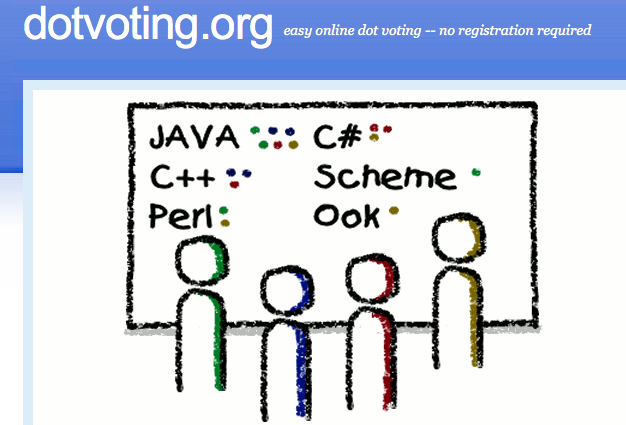
Image of the Home Page
Dot Voting - Dot voting presents participants the chance to vote anonymously on a particular topic. Unlike some other tools, Dot Voting gives participants a certain number of dots. The creator of  the dot vote determines the number of dots. The participant can administer the dots in a variety of ways, making it possible to show preferences by giving one option more dots than another. To try Dot Voting, click here to place dots about professional learning.


Image of the Home Page
Answer Garden - Answer Garden provides participants the opportunity to answer an open-ended question. All answer choices will be placed within the answer cloud below the question. In a format similar to Wordle, Answer Garden will enlarge the answer choices that become more and more popular.  In the example here, more respondents chose Twitter, so Twitter becomes bolder and larger with each entry. Answers are anonymous, and the Answer Garden question can be embedded into other sites easily. 


Image of Home Page
 Tricider - Tricider also provides participants the opportunity t vote on and share ideas. Tricider this example, I entered pros and cons about my choice for a resource.
stands out from the other two in its ability to let participants weigh pros and cons, vote, and enter an open-ended response. Tricider also provides room to explain an idea and add an image. Unlike the above choices, Tricider is not anonymous. In